
LEGENDARY BLUE DIAMONDS AND THE NIZAMS
A few Golconda blue diamonds were once part of the Nizam treasury in Hyderabad. These diamonds have an enduring legacy and get mentioned even today.
The Golconda region of South-Central India, centered around present-day Telangana and Andhra Pradesh, was historically the pre-eminent source of the world’s most celebrated diamonds. For centuries, until around the early 19th century, the Golconda diamond mines produced an extraordinary array of high-quality gems — including several of the rarest blue diamonds ever discovered. These diamonds were prized by royalty, empires, and collectors across continents, and a few have historical links with the Nizams of Hyderabad, one of India’s wealthiest royal dynasties.
THE GOLCONDA DIAMOND HERITAGE
Before diamonds were discovered in Brazil in the 18th century or Africa in the 19th, Golconda diamonds were the only known source of fine gemstones. These diamonds were generally Type IIa stones — chemically very pure, free of nitrogen impurities, and often exhibiting exceptional size and clarity. The moniker “Golconda diamond” became synonymous with the highest quality gems available in the world.
While the vast majority of Golconda diamonds are colorless or near colorless, a very small number occur naturally in shades of pink, yellow, and blue. Blue diamonds (Type IIb) are especially rare, their color is derived from trace amounts of boron within the crystal structure. This chemical rarity — combined with the scarcity of large, intensely colored stones — has made blue Golconda diamonds among the most coveted gems in history.
THE LEGENDARY WEALTH OF THE NIZAMS
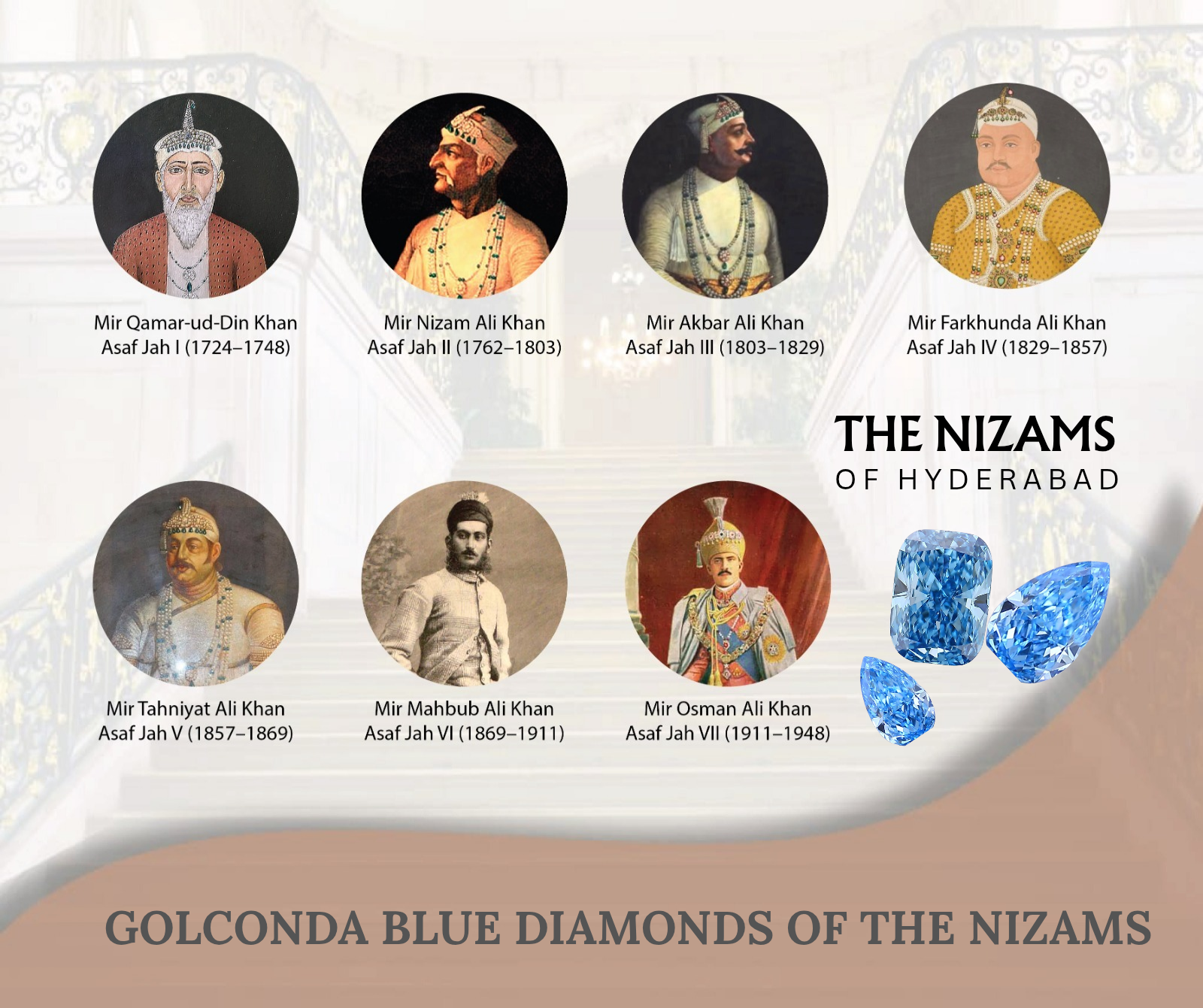
The Nizams ruled the princely state of Hyderabad from 1724 until 1948 and were historically among the wealthiest monarchs in the world. Their vast wealth came from agricultural revenues, trade, and notably their proximity to and control over the diamond trade emanating from the Golconda region. Some of the finest Golconda diamonds became part of their royal treasury, and the Nizams adorned themselves with rare gemstones and diamonds in necklaces, turban ornaments (sarpech), and ceremonial regalia.
Among the treasures attributed — in historical accounts, memoirs, and gem lore — to the Nizams are several historically significant blue diamonds. Some of these remain documented in museum collections or auction records, while others remain enveloped in legend, rumor, and mystery.
BLUE DIAMONDS IN NIZAM TREASURY
Seraphim Blue Diamond
Perhaps the most elusive and intriguing among the blue Golconda diamonds linked to the Nizams is the Seraphim Blue Diamond. According to historic narratives, this gem was a vivid blue stone mined in Golconda and became part of the treasury of the first Nizam, Asaf Jah I (Mir Qamar-ud-Din Khan, r. 1724–1748). It was reportedly set into a turban ornament — a regal headpiece worn by the Nizam on special occasions.
The fascinating part of the Seraphim Blue’s story is that it disappeared from historical records centuries ago. Some sources suggest that the second Nizam (Asaf Jah II) was given the diamond to French allies as part of a political or military agreement, taking it out of Hyderabad’s treasury. Rumors persist that the Seraphim Blue now resides in a European or Russian private collection, but no authenticated, publicly verifiable documentation has confirmed its present location.
Due to this uncertainty, the Seraphim Blue Diamond has never been exhibited at major auctions, and much of what is written about it today remains subject to interpretation and myth — though the basic narrative of its Golconda origin and historical royal ownership is consistent across secondary sources.
THE HOPE DIAMOND
The Hope Diamond is perhaps the most famous blue diamond in the world, currently housed at the Smithsonian Institution in Washington, D.C. Weighing about 45.52 carats with a deep, rich blue coloration, its history stretches back to 17th-century India. While there is no direct archival record proving it was physically part of the Nizam treasury, many historical narratives connect the Hope’s earlier phases to the broader Golconda diamond heritage, which the Nizams controlled during parts of their reign.
The Hope Diamond’s early life began as part of a larger stone (the Tavernier Blue) mined near Kollur in the Golconda region before being brought to Europe. Over centuries, it passed through French and British royal hands - eventually entering American collections and then the Smithsonian.
THE IDOL'S EYE DIAMOND
The Idol’s Eye Diamond — a very light blue, approximately 70.21-carat gem — is another stone with origins traced back to the Golconda diamond mines. First documented in the mid-19th century in London, it was later owned by the Ottoman Sultan and passed through various noble and collector hands into the 20th century. Although there is no strong verified evidence of its long-term residence in the Nizam treasury, it is frequently mentioned in lists of historic Golconda blue diamonds that circulated among royal treasuries across the Indian subcontinent — including, ostensibly, Hyderabad.
GOLCONDA DIAMONDS, RARE AND VALUABLE
Blue diamonds are intrinsically rare because boron impurities, which produce the blue hue, occur extremely infrequently in nature. Type IIb blue diamonds — such as those from Golconda — are among the rarest diamond types. In modern gemology, most blue diamonds come from South Africa or Australia, but historically it was Golconda sources that supplied the earliest known examples.
Golconda’s mines were exhausted by the early 19th century, making any diamond traceable back to those sources not only rare but also historically priceless. Additionally, royal provenance — especially involving major dynasties like the Nizams — dramatically enhances the cultural and monetary value of these gems.
GOLCONDA DIAMONDS ENDURING LEGACY
Today, blue Golconda diamonds remain among the most fascinating relics of India’s gemological history. While only a few stones such as the Hope Diamond have well-documented modern records, others like the Seraphim Blue continue to capture imaginations and sustain scholarly debate. Their links to the Nizams of Hyderabad — whether firmly documented or partly rooted in oral tradition and legend — reflect how deeply intertwined gemstones can become with the history of empires, wealth, and cultural identity.