
RUBY SAPPHIRE EMERaLD diamonds
For thousands of years, gemstones such as rubies, sapphires, emeralds, and diamonds have been closely associated with royalty, power, and divine authority. Beyond their beauty and rarity, these stones carried symbolic meanings and were often used to legitimize rule, display wealth, and convey political strength. From ancient civilizations to modern monarchies, gemstones have played a central role in royal identity, ceremony, and legacy. This report is prepared by Kaisilver the leading online custom made jewelry provider. Important to mention that, we do not deal in antique gems or jewelry and the general content in this report, is compiled to share knowledge and information. You can email our team of experts at sales@kaisilver.com if you have any queries related to gems and jewelry. It is not necessary to make a purchase from us to take advantage of our expertise in, all aspects of gemstones and jewelry includiing, gem extraction, cutting and polishing and the design and crafting of fine jewelry in gold or silver.
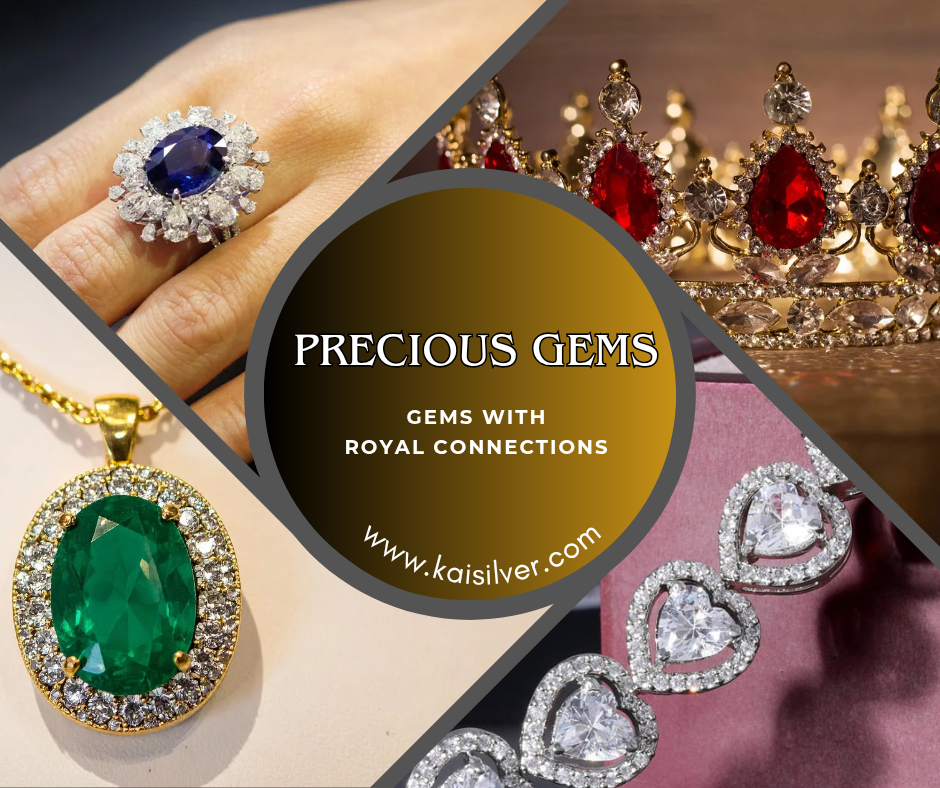
RUBY A SYMBOL OF POWER AND STATUS
Rubies, with their deep red color, have long symbolized power, vitality, and protection. In ancient cultures, red was associated with blood and life force, making rubies particularly prized by rulers. In India and Southeast Asia, rubies were often regarded as the “king of gemstones.”
The Mughal emperors of India were among the most prominent royal patrons of rubies. Emperors such as Akbar, Jahangir, and Shah Jahan collected large Burmese and Indian rubies, which were engraved with imperial titles and Quranic inscriptions. These rubies were set into turbans, swords, thrones, and ceremonial jewelry, reinforcing the emperor’s authority and divine right to rule. The famous Timur Ruby, despite being a spinel, was historically revered as a ruby and was inscribed with the names of several Mughal rulers before eventually entering the British Crown collection.
Rubies were also valued in other Asian royal courts, where they were believed to protect kings from harm and misfortune. Their association with courage and strength made them especially suitable for warrior kings and emperors.
SAPPHIRE SYMBOLIZES JUSTICE AND WISDOM
Sapphires, particularly blue sapphires, have long been linked to wisdom, justice, and divine blessing. In medieval Europe, blue sapphires were favored by kings and clergy alike, as the color blue symbolized heaven and spiritual purity.
The British Crown is perhaps the most famous modern royal institution associated with sapphires. One of the best-known examples is the Stuart Sapphire, part of the British Crown Jewels. Another iconic sapphire is the blue sapphire engagement ring worn by Princess Diana and later by Catherine, Princess of Wales. This sapphire has come to symbolize continuity, dignity, and royal tradition.
In South Asia, Kashmir sapphires achieved legendary status for their velvety blue color. The Maharajas of Kashmir and other princely states were closely associated with these rare gemstones. Although modern research has challenged exaggerated claims about crowns studded with Kashmir sapphires, these stones were undoubtedly prized by Indian royalty and collected by maharajas as symbols of prestige and refined taste.
EMERALDS SYMBOLIZE FERTILITY AND REGENERATION
Emeralds have been associated with fertility, rebirth, and eternal youth since antiquity. Cleopatra, the famed queen of Egypt, is one of the earliest and most iconic royal figures linked to emeralds. She is known to have controlled emerald mines in Egypt and frequently wore emerald jewelry. Cleopatra reportedly presented emeralds engraved with her likeness as diplomatic gifts, using gemstones as instruments of power and political influence.
In the Indian subcontinent, emeralds became especially significant during the Mughal period. The Mughal emperors amassed extraordinary collections of Colombian emeralds, which were carved with inscriptions, floral motifs, and religious texts. These emeralds were worn as talismans, set into royal ornaments, or used in court regalia. Their green color symbolized paradise and prosperity in Islamic culture, making them particularly meaningful to Mughal rulers.
The Nizams of Hyderabad also became legendary for their emerald collections. As some of the wealthiest rulers in the world during the early twentieth century, the Nizams possessed emeralds of exceptional size and quality. Many of these gemstones were incorporated into elaborate necklaces, brooches, and turban ornaments, reflecting both immense wealth and royal refinement.
DIAMONDS ARE A SYMBOL OF PERMANENCE AND TRUTH
Diamonds, due to their unmatched hardness and brilliance, have long symbolized invincibility, permanence, and supreme authority. Indian mines were the primary source of diamonds for centuries, and many of the world’s most famous diamonds passed through royal hands.
The British Crown Jewels contain some of the most renowned royal diamonds, including the Cullinan diamonds, cut from the largest gem-quality diamond ever discovered. These stones are set into the Sovereign’s Sceptre and the Imperial State Crown, representing imperial power and continuity.
In India, the Nizams of Hyderabad were famous for their diamond wealth. The Jacob Diamond, one of the largest polished diamonds in the world, was owned by the Nizams and exemplifies their extraordinary access to rare gemstones. Diamonds were used not only as ornaments but also as symbols of economic and political dominance.
The Maharajas of Kashmir and other princely rulers also possessed diamonds, often integrated into ceremonial jewelry and court regalia, though modern historians emphasize that such usage was more restrained and culturally distinct than European crown traditions.
CONCLUSION
Across civilizations and centuries, gemstones have served as far more than decorative objects for royalty. Rubies conveyed strength and protection, sapphires symbolized wisdom and divine favor, emeralds represented renewal and sovereignty, and diamonds stood for permanence and absolute authority. Royals such as Cleopatra, the Mughal emperors, the British monarchs, the Nizams of Hyderabad, and the Maharajas of Kashmir used gemstones to express power, legitimacy, and cultural values.
These historic associations continue to shape how gemstones are perceived today, lending them a timeless aura of prestige and significance that extends far beyond their material beauty.